Noob Battle: War Sandbox
Q8PowerSimulation
0.00.00 Reviews
- Version
- 2.1.2
- Installs
- 50.00K
- Age Rating
- Everyone
Screenshots
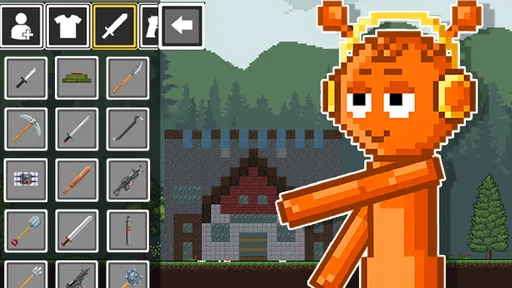
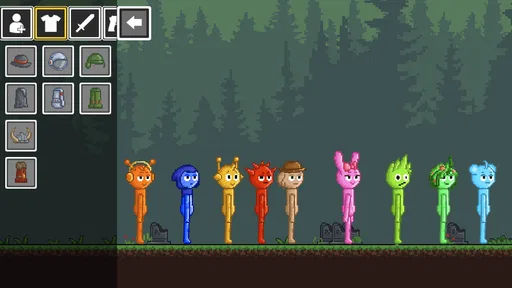
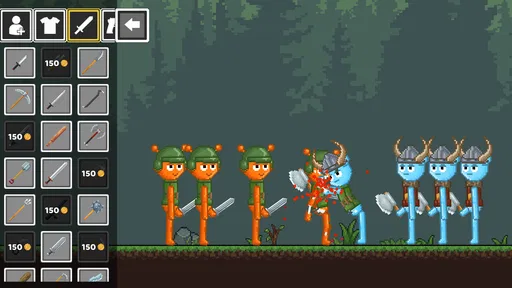
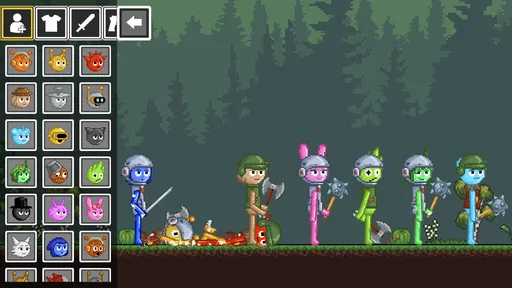
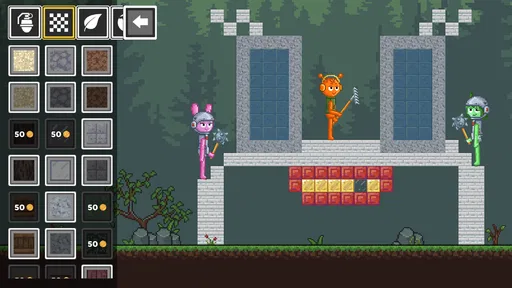
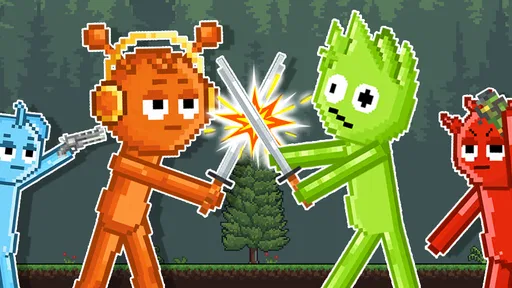
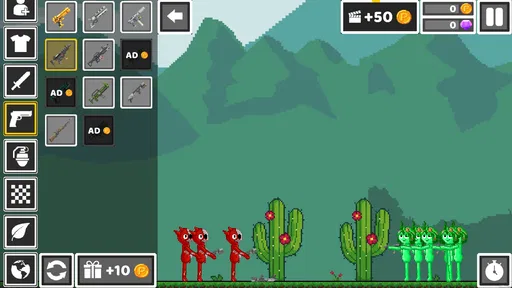
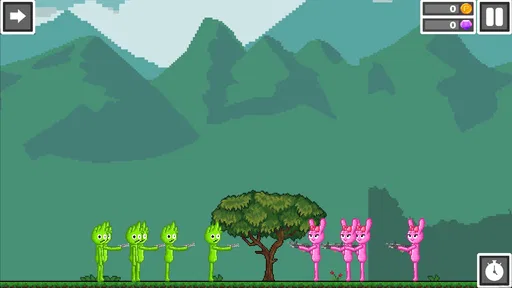
Our Review of Noob Battle: War Sandbox
 Analysis by Appyee
I spent time with Noob Battle: War Sandbox as a lighthearted simulation game built around improvised battles, simple characters, and physics that can turn a carefully planned attack into a pile of flying bodies. Its appeal is easy to understand: instead of demanding a long tutorial or a serious strategy commitment, it lets me set up a ridiculous conflict and then watch the sandbox produce the result.
That makes it a good fit for short sessions. I can open it when I have a few minutes, experiment with a different arrangement, and stop after a handful of battles without feeling that I have abandoned a complicated campaign. At the same time, the physics-driven format means the entertainment comes as much from unexpected reactions as from winning. The real attraction is controlled chaos rather than deep military realism.
How the current version feels to play
The game is presented as a free simulation title from Q8Power, with a general Everyone content rating. It is available for Android devices running at least Android 7.0, which keeps the basic compatibility floor fairly approachable for people using older phones. The current version is 2.1.2, and that version number matters because the experience feels like an established sandbox rather than a one-screen experiment that has only just appeared.
My first useful lesson was not to treat each encounter like a conventional strategy game. In a typical battle title, I expect a reliable relationship between a unit choice and its result. Here, positioning and momentum can matter just as much as the apparent strength of the fighters. A crowded starting formation may look powerful, but it can also create a messy collision that prevents the front line from moving effectively.
I found it more enjoyable to begin with a simple arrangement, observe the first clash, and then change one thing at a time. Moving a group slightly, separating units, or giving one side more room can reveal why a battle unfolded differently. This makes the sandbox useful even when the outcome is not a victory. The failed attempt becomes a small experiment instead of wasted time.
That approach also helps with the game’s biggest possible source of frustration: physics can make results feel unpredictable. If I want a precise, repeatable tactical contest, the loose behavior may feel unfair. If I accept that a stumble, collision, or ragdoll reaction is part of the entertainment, the same event becomes the reason to try again.
Why the ragdoll physics changes the experience
Ragdoll movement is not just visual decoration here. It changes how I judge a battle. A unit that appears to be in control can be knocked away, while a crowded group can lose its shape after one impact. The aftermath often tells a more entertaining story than the opening setup, especially when several characters react to the same collision in sequence.
For practical play, I recommend watching the first few seconds without immediately restarting. That pause shows whether the problem came from the number of fighters, the starting distance, or the way the two groups met. Once I understood that, I could create more interesting tests instead of simply repeating the same arrangement and hoping for a different result.
This is also where the game differs from more traditional strategy games. Those games usually reward memorizing counters, improving a fixed roster, or following a carefully balanced build. Noob Battle is better when I want to explore a situation. It is less satisfying when I need a finely tuned competitive system where every loss has a clearly measurable cause.
Small-session use and a realistic everyday scenario
I can imagine using it during a short break when I do not want to commit to a story mission or an online match. A realistic routine would be to create one battle before a commute, watch the result, then adjust the setup during the next break. Because the central loop is easy to understand, I do not need to remember a large inventory or a complicated set of objectives after putting the phone down.
It also works as a casual pass-around game. One person can make a battle setup, another can suggest a change, and both can watch the physics decide what happens. That shared experimentation is more appealing than pretending the game offers a serious simulation of warfare. The simple “what if?” question is the strongest reason to show it to a friend.
On the other hand, I would not choose it for a long uninterrupted evening if I wanted a sense of progression, narrative, or increasingly demanding strategic planning. The sandbox format can provide many amusing variations, but it does not automatically create a larger purpose. Players who need missions, character development, or a strong competitive ladder may find the loop too open-ended.
What the version and release history suggest
The game was released on August 5, 2026, and the current 2.1.2 build suggests that Q8Power has already moved beyond an initial launch state. I would read that as a reason to expect a more settled basic experience than an early prototype, while avoiding the assumption that every part of the game has been expanded or refined equally.
For someone installing it now, the practical benefit of using the current build is that the core presentation should represent the developer’s present direction rather than the earliest release. I would still judge it on what is available in the actual sandbox: how quickly battles begin, how readable the action remains, and whether repeated experiments continue to feel amusing after the novelty fades.
The version number alone does not tell me that the game has become a full-scale strategy product. What it does tell me is that the app has an ongoing development path. That makes future improvements worth watching, especially if Q8Power focuses on giving players more meaningful reasons to revisit their experiments rather than only adding more visual commotion.
What existing users may notice
Players who have been using an earlier build will probably judge the current release less by its basic premise and more by its smoothness and consistency. The important question is whether setting up a battle feels quick enough to encourage another attempt. In a physics sandbox, small usability details have an outsized effect: a clear setup flow can make experimentation feel natural, while unnecessary friction can make even a funny result feel like work.
My advice to returning users is to revisit the game with a testing mindset. Try a familiar arrangement first, then alter one variable rather than changing everything. That makes it easier to notice whether the current build handles collisions, spacing, and large groups in a way that feels more dependable. It is also a better method for separating a genuinely different result from ordinary physics variation.
New players should do the opposite of what they might do in a conventional battle game: resist the urge to build the biggest possible force immediately. A smaller setup is easier to read, and it teaches how the characters interact. Once the movement makes sense, larger battles become more entertaining because I can recognize when the chaos came from a deliberate choice.
Three useful habits that improve the sandbox
Start with symmetrical groups when learning the game. This gives me a clearer baseline and makes the effect of changing position easier to see.
Change only one part of a setup after a surprising result. Replacing the entire arrangement hides the useful lesson and turns the next battle into another guess.
Use failures as demonstrations of space and momentum. A collapse at the front may suggest that the formation is too tight, while a scattered result may show that the groups meet with too much force or too little support.
These habits are more valuable than blindly repeating a favorite formation. They turn the game from a random spectacle into a small interactive laboratory. I still cannot expect every outcome to be perfectly predictable, but I can make my experiments more deliberate and more entertaining.
Where the current experience still has limits
The main limitation is the same feature that makes the game memorable: loose physics can reduce the feeling of control. A player may create what looks like a sensible plan and then watch it unravel because of one awkward collision. That is funny for a while, but it can become tiring if there are not enough fresh situations or goals to keep the experiments meaningful.
The open sandbox also places more responsibility on the player. There is no guarantee that every session will feel equally rewarding. I need to bring my own challenge, such as comparing formations, recreating a particular kind of clash, or trying to win with fewer fighters. Without that self-imposed structure, the game may feel shallow next to a campaign-based alternative.
Another trade-off is accessibility versus depth. The straightforward concept makes the game easy to approach, including for younger players covered by its Everyone rating. However, the same simplicity may disappoint experienced simulation fans who expect detailed systems, long-term management, or realistic battlefield behavior. This is a playful sandbox, not a substitute for a serious war simulator.
Device compatibility is reasonably welcoming because the minimum requirement is Android 7.0, but that does not guarantee identical comfort on every phone. Physics-heavy scenes can be more demanding than a static menu, so I would begin with modest battles on an older device and increase the scale gradually. That is a sensible way to check readability and responsiveness without assuming that every handset will behave the same way.
Who should install it and what to watch next
At no cost, the game is easy to try, and its audience is clear. I would recommend it to players who enjoy ragdoll humor, quick experiments, and creating battles that are entertaining even when they go wrong. It is especially suitable for people who like sandbox toys more than structured campaigns and for friends who want to compare setups without learning a complicated rulebook.
I would suggest skipping it if your priority is a deep progression system, historically grounded combat, or highly predictable competitive balance. A conventional tactics game will be a better choice when you want every decision to have a carefully explained consequence. A story-driven game will serve you better when you need characters and objectives to carry the session forward.
The game has passed the small-experiment stage in terms of its release path, but its next important step should be judged by substance rather than by a larger version number. I would watch for improvements that make repeated battles more purposeful: clearer ways to compare experiments, stronger reasons to revisit different setups, and refinements that preserve funny physics without making outcomes feel completely arbitrary.
I would also pay attention to how well the current build handles the balance between spectacle and control. If future development adds variety while keeping the setup quick, the sandbox could remain enjoyable for longer sessions. If it only increases the amount of chaos, the novelty may wear off faster for players who already understand the basic loop.
My final view is positive but specific. Noob Battle: War Sandbox is not trying to replace a full strategy campaign, and I would not recommend it on that basis. I recommend it as a playful physics simulator for short breaks, casual challenges, and moments when watching a plan collapse is more fun than executing it perfectly. Its best results come from treating each battle as an experiment, accepting a little unpredictability, and creating your own reasons to try one more setup.
Q8Power has a clear foundation to build on. The current version offers an approachable way to stage noob battles and enjoy ragdoll reactions without paying to begin. For me, that is enough to keep it installed as a quick sandbox diversion, provided I approach it for spontaneous fun rather than demanding the depth and precision of a dedicated tactical game.
Verdict
Strengths of Noob Battle: War Sandbox
- Simple controls make battles easy to start and understand.
- Sandbox freedom encourages creative strategies and unusual experiments.
- Short matches work well for quick gaming sessions.
- Unit variety adds replay value to different battle setups.
- Offline play is useful when an internet connection is unavailable.
Limitations of Noob Battle: War Sandbox
- Graphics may feel basic compared with newer strategy games.
- Large battles can become visually cluttered on smaller screens.
- Progression may feel repetitive after extended play.
- Some features or units may require in-app purchases.
- The game can drain battery during longer battles.
Other Releases by Q8Power
View All
KPOP Sandbox: Demon Hunters
Simulation3.9
Similar Picks in This Category
View All
Truckers of Europe 3
Wanda Software4.3

Town Building Life Simulator
XGame Global4.2

Fidget Toys Trading・Pop It 3D
Freeplay Inc4.7

Sculpt People
CrazyLabs LTD4.4

Scary Teacher 3D
Z & K Games4.2

Hair Tattoo: Barber Shop Game
CASUAL AZUR GAMES4.3
Frequently Asked Questions
What is Noob Battle: War Sandbox?
Noob Battle: War Sandbox is a physics-based battle and simulation game centered on creating chaotic fights with customizable characters, weapons, vehicles, and environments. Instead of following a traditional story campaign, you generally experiment with different units and setups, then watch the action unfold. Its appeal comes from sandbox freedom, humorous visuals, unpredictable physics, and the ability to replay scenarios in different ways.
How does the gameplay work in Noob Battle: War Sandbox?
Gameplay usually involves selecting fighters, placing them on a battlefield, equipping them with available weapons or tools, and starting the simulation. Once the battle begins, the units act according to the game’s rules and physics, producing unexpected results. Players can test different combinations, adjust the battlefield, and repeat encounters to discover more entertaining or effective strategies rather than simply completing linear missions.
Is Noob Battle: War Sandbox suitable for children?
The game’s colorful, block-style presentation may look suitable for younger players, but parents should still review its content before allowing children to play. Battles can include weapons, explosions, fighting, and cartoon-style violence. The exact suitability may also depend on the age rating shown in the Google Play Store or App Store, as well as whether advertisements, purchases, or online features are available in the current version.
Does Noob Battle: War Sandbox require an internet connection?
Many sandbox battle features may be playable offline after the game has been installed, which makes it convenient for short sessions without mobile data. However, an internet connection can still be required for downloading updates, loading advertisements, accessing online content, restoring purchases, or using any multiplayer or cloud-related functions. Check the store description and test the installed version because requirements can change with updates.
Is Noob Battle: War Sandbox free to download and play?
Noob Battle: War Sandbox may be offered as a free download, but free access does not always mean that every feature is available without limitations. Depending on the version, the game may contain advertisements, optional in-app purchases, locked content, or rewards connected to viewing ads. Before downloading, check the official store listing for the current pricing, permissions, age rating, and purchase information.
Play our best games!


